
How to Measure the Neck Finish of Your Bottle or Cap
- ByRobert "Rob" Starmann
- April 2, 2026
A single measurement mistake can derail an entire product launch. The global packaging market is expected to reach $1.69 trillion by 2034, with plastic packaging growing at 4 percent annually. The competition is fierce, and every detail counts.
When containers and plastic caps don’t align perfectly, the impact goes far beyond aesthetics: filling lines can stall, sealing failures may cause product loss, and inventory might need to be discarded. The right measurement knowledge avoids these disruptions altogether.
Ashland Container’s 50+ years in the packaging industry have proven that even millimeter-level dimension errors can shut down entire production lines, and how precise measurements keep operations running smoothly from filling to final delivery.
What Is a Bottleneck?
A bottleneck refers to the narrow, tapered section connecting the bottle body to the opening, creating better pouring control and allowing various closure options.
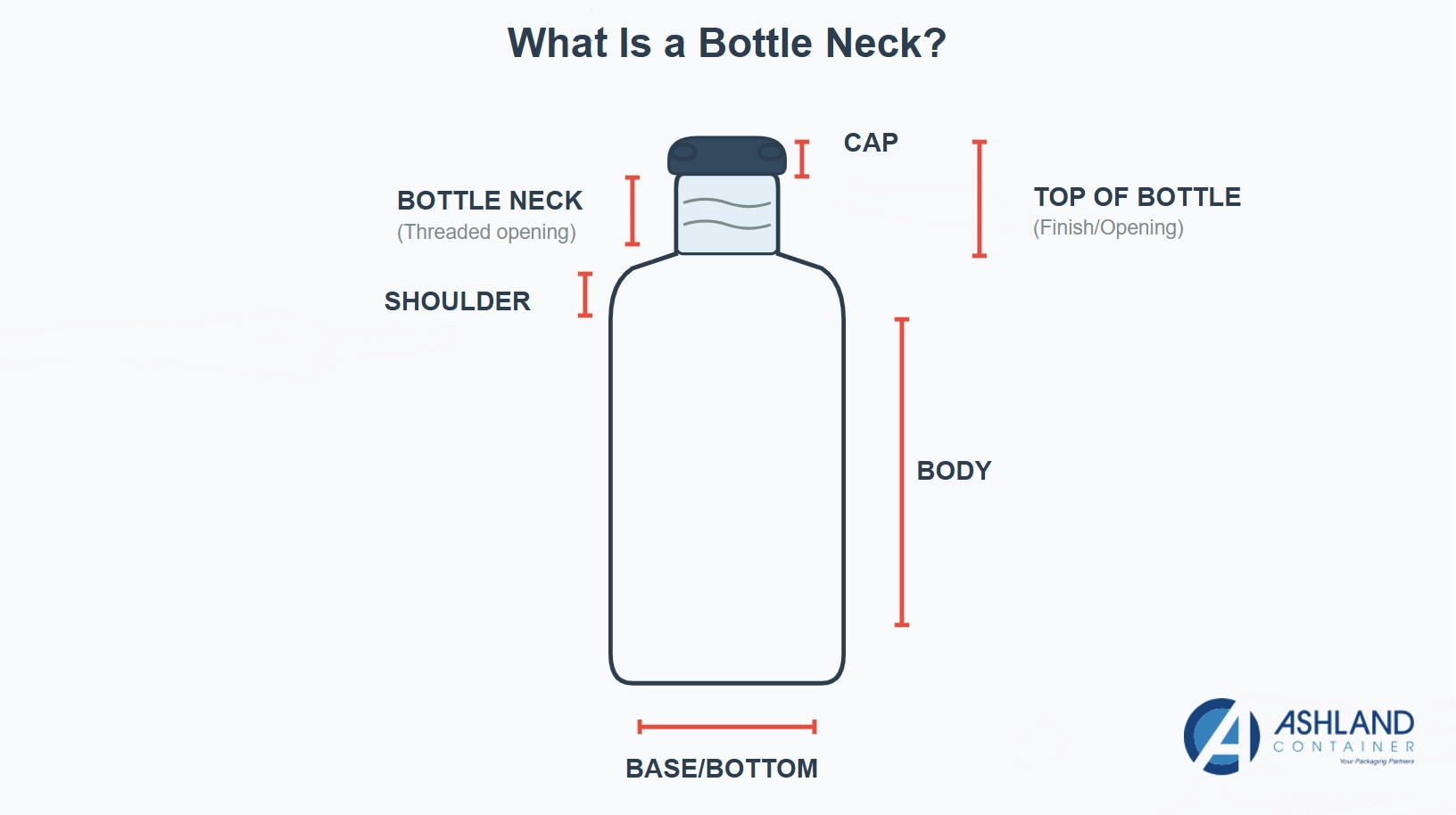
The neck finish specifically refers to the threaded portion where caps attach and seal. Choosing the right bottleneck dimensions is critical for business success, as incorrect measurements can lead to expensive production delays, product recalls, and compatibility issues with automated filling equipment. Selecting the proper neck reduces manufacturing costs and maintains product integrity throughout the supply chain.
Essential Neck Finish Dimensions You Need to Know
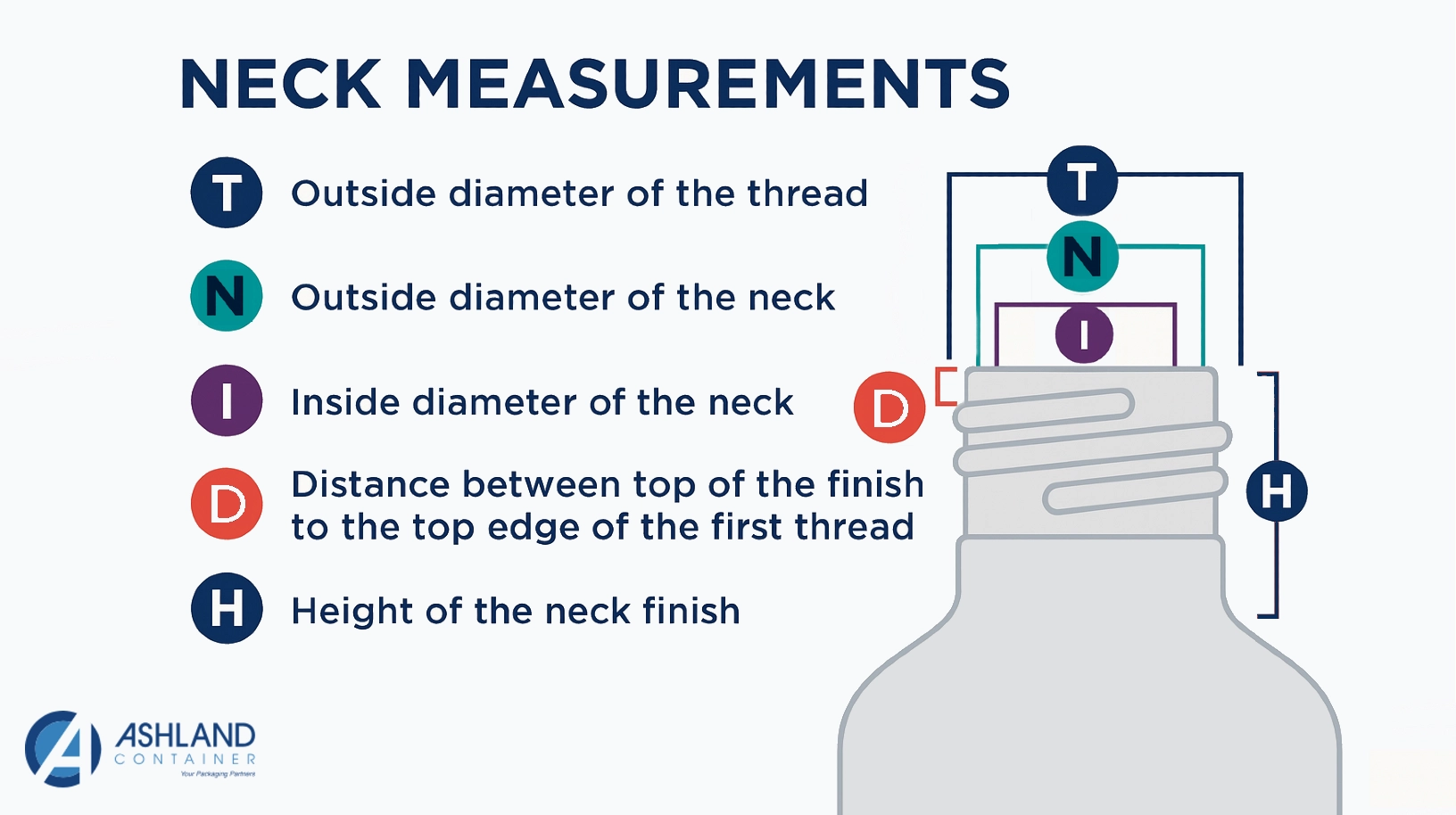
Understanding the five critical dimensions — often referred to as "T", "N", "I", "D", and "H" — forms the foundation of accurate bottle cap measurements.
The "T" Dimension (Thread Diameter)
The "T" dimension measures the outside diameter of the threads and determines which closure will fit your container. This measurement is taken across the widest point of the external threads and directly corresponds to the first number in your neck finish designation.
The "N" Dimension (Neck Diameter)
The "N" dimension represents the outside diameter of the neck itself, measured at the point where threads begin. The difference between "N" and "T" dimensions, divided by two, provides the thread depth, a critical factor for proper closure engagement.
The "I" Dimension (Inner Diameter)
The inner diameter of the bottleneck affects filling operations and closure sealing. Specifications require a minimum "I" dimension to allow sufficient clearance for filling equipment, while linerless closures and dispensing fitments need controlled inner dimensions for proper functionality.
The "D" and "H" Dimensions
The "D" dimension measures from the top of the finish to the first thread's top edge, determining closure orientation and thread engagement. The "H" dimension represents the total height of the neck finish, measured from the top down to where the thread diameter intersects with the bottle shoulder.
Common Bottle Cap Size Chart and Applications
Bottleneck finishes use two numbers separated by a dash or slash. The first number is the thread diameter in millimeters, and the second indicates the thread style.
The 38-400 neck finish, with a 38mm outer thread diameter and a single-turn 400 thread, is the most commonly used standard across food, beverage, and industrial packaging. Its widespread compatibility with both glass and plastic containers makes it a go-to choice for manufacturers who need flexibility in cap sourcing and filling line integration.
Here are the most common neck finish sizes:
Helpful note: 1 turn = one complete spiral of threading.
Step-by-Step Bottleneck Finish Measurement Process
The measurement process helps capture precise dimensions that directly affect cap compatibility, sealing strength, and production efficiency. To avoid costly misfits, follow a proven method used across industries.
To measure bottleneck finishes accurately, you'll need a few basic tools. Each plays a role in ensuring your measurements are reliable and repeatable:
Measuring the Thread Diameter
Place your calipers across the widest point of the external threads, ensuring you're measuring the actual thread peaks instead of the neck body. Take measurements at multiple points around the circumference to account for any manufacturing irregularities.
Determining Thread Style
Count how many times the thread wraps around the neck. One complete revolution indicates a 400 finish, while one and a half turns typically represents a 410 finish. Some containers feature deeper threads (430 finish) or multiple turns (415, 425 finishes).
Measuring Internal Dimensions
For the inner diameter, measure across the opening at the narrowest point. This value directly impacts the filling process and affects compatibility with pumps, sprayers, reducers, or other dispensing components commonly used in both industrial and consumer applications.
Industry Standards and Compatibility
The Glass Packaging Institute (GPI) and Society of Plastics Industry (SPI) have established standardized measurements to ensure compatibility between manufacturers. These standards cover thread pitch, height specifications, and dimensional tolerances.
Continuous thread finishes, the most common type, feature unbroken threads that spiral around the neck. This design works with standard screw-on caps and has excellent sealing properties for most applications.
However, some industries go beyond general standards and need application-specific finishes:
- Pharmaceutical and nutraceutical packaging: Typically uses 45-400 or 53-400 finishes. These larger neck openings accommodate bulk filling operations while maintaining precise control over closure for product safety.
- Food and beverage applications: Food applications often require specific bottle cap dimensions to meet FDA regulations and ensure the product stays fresh. The 38-400 finish dominates this market due to its versatility and wide closure selection.
- Chemical and Industrial uses: Industrial applications may require specialized finishes, like the 38-430 buttress style, designed for controlled pouring and enhanced durability under harsh conditions.
Common Measurement Mistakes to Avoid
Accurate bottleneck measurements are essential for choosing the correct closure and ensuring a proper seal. However, even experienced professionals can overlook small but critical details. We’ve outlined some common mistakes that can result in poor fit, leakage, or production delays — here’s what to avoid and why it matters.
Threading vs. Neck Confusion
Many people incorrectly measure the neck diameter instead of the thread diameter. Always measure at the thread peaks for accurate "T" dimension readings.
Incomplete Thread Counting
Partial thread turns can be misleading. Trace the complete thread path around the neck to determine the actual finish style.
Ignoring Manufacturing Tolerances
Standard manufacturing tolerances typically allow ±0.5mm variation in dimensions. Factor these tolerances into your compatibility assessments.
Quality Control, Testing, and Troubleshooting

Once you’ve identified the correct bottle and neck measurements, physical testing is essential. Measurements alone can’t reveal real-world issues such as poor thread engagement or inconsistent sealing. Always test with actual closures to confirm fit and function.
To ensure packaging performs as expected, conduct standard quality control procedures such as:
- Drop tests: Simulate handling and transport stress.
- Torque tests: Measure opening and closing force.
- Seal integrity evaluations: Check for leaks under pressure or temperature changes.
Despite careful planning, issues can still happen. Here’s how to troubleshoot the most common ones:
- Loose cap fit: Check your thread dimensions and inspect for wear or damage. If the fit still feels off, try a different closure style that’s still compatible with your chosen neck finish.
- Difficult cap removal: This usually signals mismatched thread pitch or improper torque during capping. Double-check the closure specs and recalibrate your equipment if needed.
Effective testing and troubleshooting help prevent failures after production, protecting your product, reputation, and bottom line.
Need Expert Packaging Consultation?
We know that selecting the right bottle and cap combination can be complex. Our packaging specialists can help you navigate the dimensions of bottle cap requirements and ensure perfect compatibility for your application.

Finding the Perfect Fit with Ashland Container
Measuring your bottle’s neck finish correctly helps avoid the most common packaging issues, like leaking closures, incompatible caps, and costly rework. When measurements are accurate, your production runs smoothly, sealing is more reliable, and your product stays protected from the filling line to the customer shelf.
At Ashland Container, we help businesses like yours eliminate guesswork and ensure perfect cap-to-bottle matches. Leverage our 50+ years of experience so you can avoid expensive mistakes! Our team can assist with selecting the correct neck finish, navigating industry standards, and even testing samples for real-world performance.
Need help confirming your measurements or choosing the right closure? Contact us for a free consultation and take the next step toward packaging confidence.

Recent Posts

Benefits of Clear Containers: Why Transparency Matters
Explore the benefits of clear plastic packaging and how it boosts brand visibility, trust, and safety, based on Ashland Container's 50+ years of experience.

Packaging Compatibility Testing: Your Guide to Packaging Quality Assurance and Standards
Prevent recalls and protect customers with packaging compatibility testing methods and standards that keep packaging safe and reliable with Ashland Container.

How to Select the Best Plastic Bottle for Your Liquid Product
Learn how to choose the best plastic bottle for liquids by comparing materials, shapes, functionality, and labeling — ensure you make the right packaging choice with Ashland Container’s help.